
Fayetteville Previous Resident Sources
A Fayetteville house history works best as an era-by-era file, not a single result. Cumberland County land books establish recorded transfers, while directories, census schedules, maps, permits, newspapers, and estate material supply dated evidence around the same address. The oldest land-book date and the earliest online result are not the same thing. Start with the source nearest to the time in question, then compare it with a second record before treating an owner, occupant, or building date as settled.
| Fayetteville source | Era available | Access route | Evidence it can add |
|---|---|---|---|
| Fayetteville CCROD land and deed books | Cumberland land records from 1754; earliest online year unverified | Fayetteville online search, counter, or Archives microfilm | Recorded parties, legal description, book/page, date, and chain references |
| Fayetteville Bernard’s directory | 1866–67 | Fayetteville NPS/HPO bibliography; confirm local shelf access | Early city, business, and resident context |
| Fayetteville Gardiner, Hill, and Legion directories | 1909–10, 1915–16, 1924, and 1928 | Fayetteville DigitalNC, UNC/Duke, and library collections | Names, streets, household, business, and phone clues |
| Later Fayetteville Hill’s runs | 1937, 1939, 1948–49, 1951, 1953, 1954–55; later 1956–69 references and a 1968 record | Fayetteville library, DigitalNC, and HPO bibliography | Address and occupancy snapshots between censuses |
| Fayetteville federal census trail | Public releases follow the 72-year rule | Fayetteville library, National Archives, or permitted genealogy collections | Household relationships, ages, birthplace, and occupation at one census date |
| Fayetteville Sanborn maps | 1885, 1891, 1896, 1908, 1914, 1923, 1930, and 1958 | Library of Congress, Fayetteville NPS bibliography, library, or archive routes | Footprint, use, street label, and nearby intersections |
| Fayetteville city permit records | Fayworx from December 2014 through transition; E-Development after 2021 | Fayetteville city portals and targeted records requests | Project, work, inspection, and date context |
| Fayetteville code cases | Public spreadsheet covers the prior 12 months; older span unverified | Fayetteville Code Enforcement dashboard, spreadsheet, or request | Address, status, violation category, and date context |
| Fayetteville Observer | Library archive from 1988; selected archival reels reach 1789–1900 and 1909–17 | Fayetteville library and State Archives | Obituaries, notices, events, and property references |
| Fayetteville probate and estate records | Current Clerk files; FamilySearch collections span 1663–1979 and 1735–1970 | Fayetteville Clerk, Archives, and collection access routes | Decedent, heirs, administrator, property, and dates |
Use a Fayetteville deed when the question is title, and a Fayetteville directory or census when the question is occupancy. A Fayetteville permit can date work, but it does not establish a household. The same distinction applies to a Fayetteville tax listing and a mailing address. Note: a gap in one Fayetteville source may reflect its coverage or access route, not proof that the address or person did not exist.
Freeze Fayetteville Resident Addresses
Copy the Fayetteville historical address exactly before normalizing it. Keep the printed street spelling, number, community name, source page, date, and a confidence note in one log. Then use Cumberland County GIS to locate the current Fayetteville parcel, address point, surrounding streets, and map layers. The county tax search can then supply the Fayetteville parcel key, listed owner, and current or prior-year abstract. That sequence prevents a modern postal label from overwriting the historical wording.
A Fayetteville situs address is the physical parcel location. A Fayetteville mailing address is where correspondence goes, and it may be elsewhere. The legal description in a Fayetteville deed or plat uses lot, block, subdivision, or metes-and-bounds language. It is often the stronger bridge when street numbers changed, a parcel was split, or a neighborhood was annexed. Cumberland’s captured tax material does not expose every live parcel-card label, so record only the fields actually displayed.
- Parcel identifier
- The county Tax and GIS key for one mapped piece of land. Use the number returned by the live result rather than guessing its format.
- Situs address
- The physical property location used for mapping, permits, and code records. It is not automatically the owner’s mailing location.
- Legal description
- The deed or plat description that ties land to a lot, block, subdivision, or boundary calls even when the street string changes.
Fayetteville Deed Chain for Past Residents
The Cumberland County Tax Administration search accepts bill number, parcel number, owner name, and street name for its documented paths. Carry the Fayetteville listed owner and legal description to the CCROD records search. CCROD indexes Fayetteville real-estate records alphabetically by grantor and grantee, not by street address. A grantor is the seller or party conveying an interest. A grantee is the buyer or party receiving it.
Fayetteville CCROD staff can explain indexing and copy procedure, but North Carolina law does not allow staff to perform a title search for the researcher. Read the Fayetteville instrument image rather than relying only on its index line. The image can contain the legal description, referenced prior instrument, parties, acknowledgment, and lot or map information that makes the next link in the chain clear.
For a view of the county’s title-search guidance, open the CCROD grantor-grantee FAQ before working backward through the names.
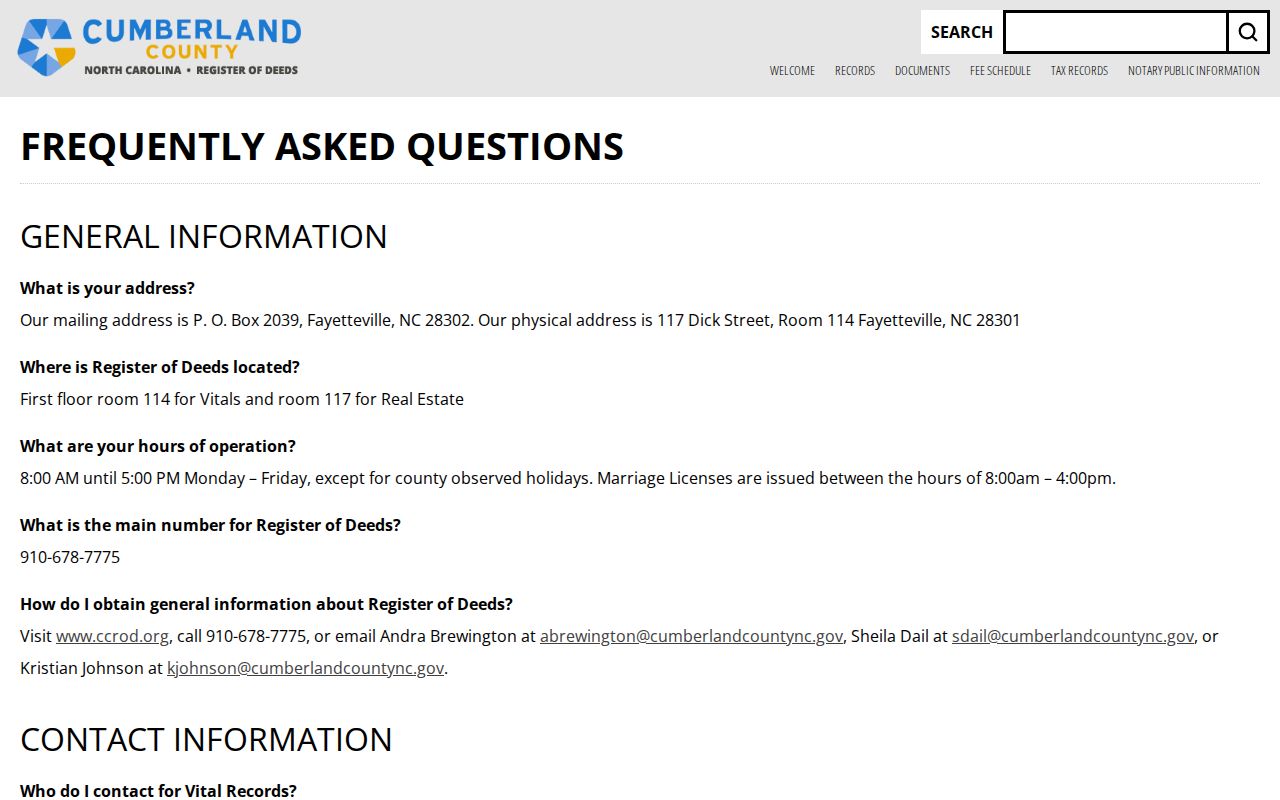
The FAQ reinforces the key local limit: an address must first become a parcel, legal description, and party-name trail before it becomes a recorded deed search.
- Locate the current Fayetteville parcel in GIS and save its tax identifier, listed owner, situs address, and legal description.
- Search that Fayetteville owner as a grantee in CCROD to find the acquisition instrument, then note the grantor, recording date, book/page or document number, and prior references.
- Search that grantor as a grantee to locate the earlier Fayetteville purchase. Repeat the process, including name variants, married or former names, trusts, and entities when the record supports them.
- Compare Fayetteville legal descriptions and referenced instruments at every link. A chain of title is this documented sequence of transfers, not a list of people inferred from an address.
- When the online trail becomes unclear, take the Fayetteville book/page and date to the CCROD counter, State Archives, FamilySearch Wills and Deeds collection, or library instead of filling the gap by assumption.
Fayetteville Previous Resident Books
Cumberland County land records, kept in Fayetteville, begin in 1754. CCROD makes Fayetteville document images and scanned index books available as PDFs through its records-search workflow, and plats may be online. The public information reviewed for this project does not state one earliest online index or image year. That boundary remains unverified, so an empty online search cannot prove the Fayetteville deed chain ends there.
For a Fayetteville paper-only interval, ask CCROD about the cited book/page and use the North Carolina State Archives government-records route to identify transferred county books or microfilm. FamilySearch probate collections are another Fayetteville access channel when collection rules permit viewing. Requests work better with party names, date range, book/page, parcel or legal-description details, and whether an ordinary or certified copy is needed.
The State Archives catalog is a useful starting point for older Fayetteville and Cumberland groups, including county material that may not appear in a current online deed result.
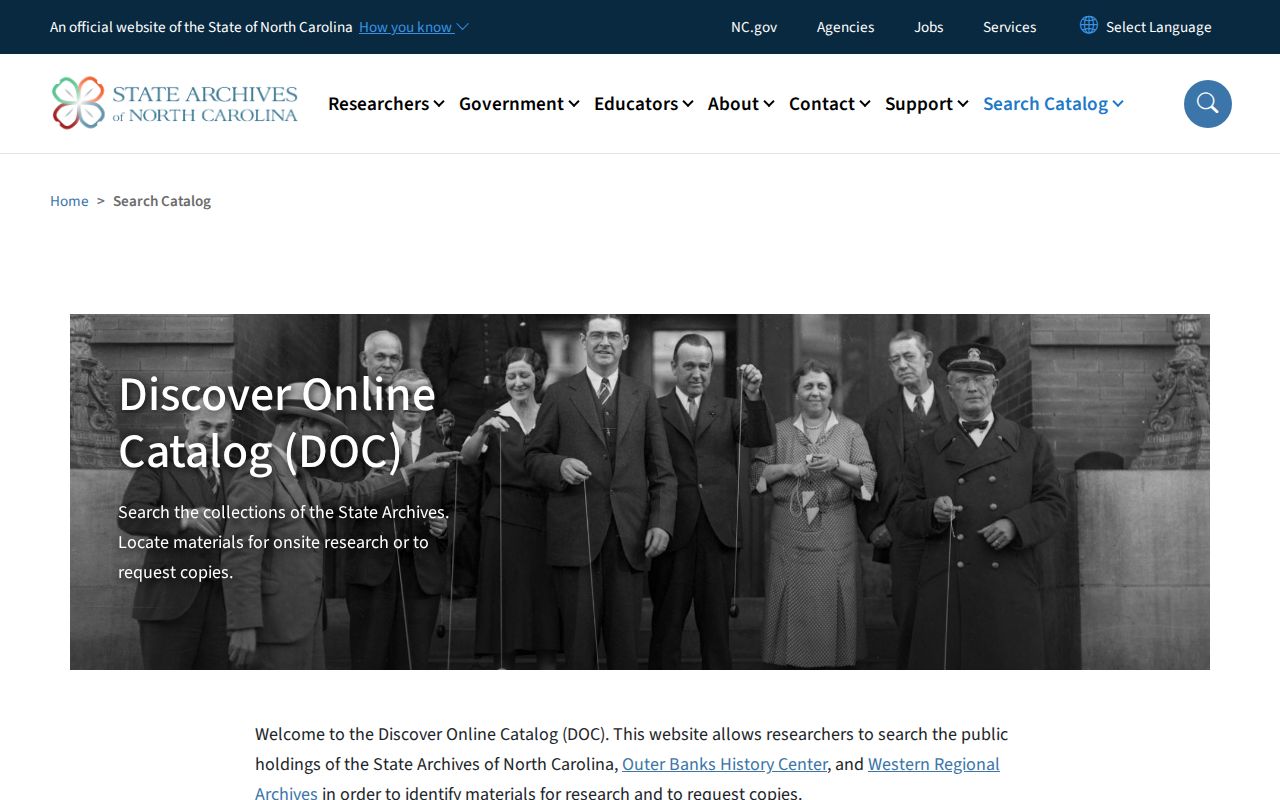
Fayetteville archive holdings and microfilm routes vary by series, so confirm the relevant record group before traveling or ordering a copy.
Fayetteville Past Household Directories
Fayetteville printed volumes fill many of the spaces between transfers. Fayetteville has an 1866–67 Bernard’s directory, DigitalNC runs for 1909–10, 1915–16, 1924, and 1928, plus documented Hill’s runs for 1937, 1939, 1948–49, 1951, 1953, and 1954–55. References also list local runs in 1951, 1953, 1954, and 1956–69, with a DigitalNC record for 1968. These are snapshots, not an unbroken annual roll.
The 1959 Fayetteville Hill’s volume shows why one book can solve several parts of a house history. Its introduction describes Yellow Pages, an alphabetical adult-resident section, a Fayetteville Householders street guide, and a numerical telephone directory. Start with the street and number in the Householders section, then test the person in the alphabetical section. The numerical telephone section can help when a name is hard to read. The broader collection details belong with the Fayetteville city directory research path.
For historical context from a local collection, consult the Museum of the Cape Fear Historical Complex.
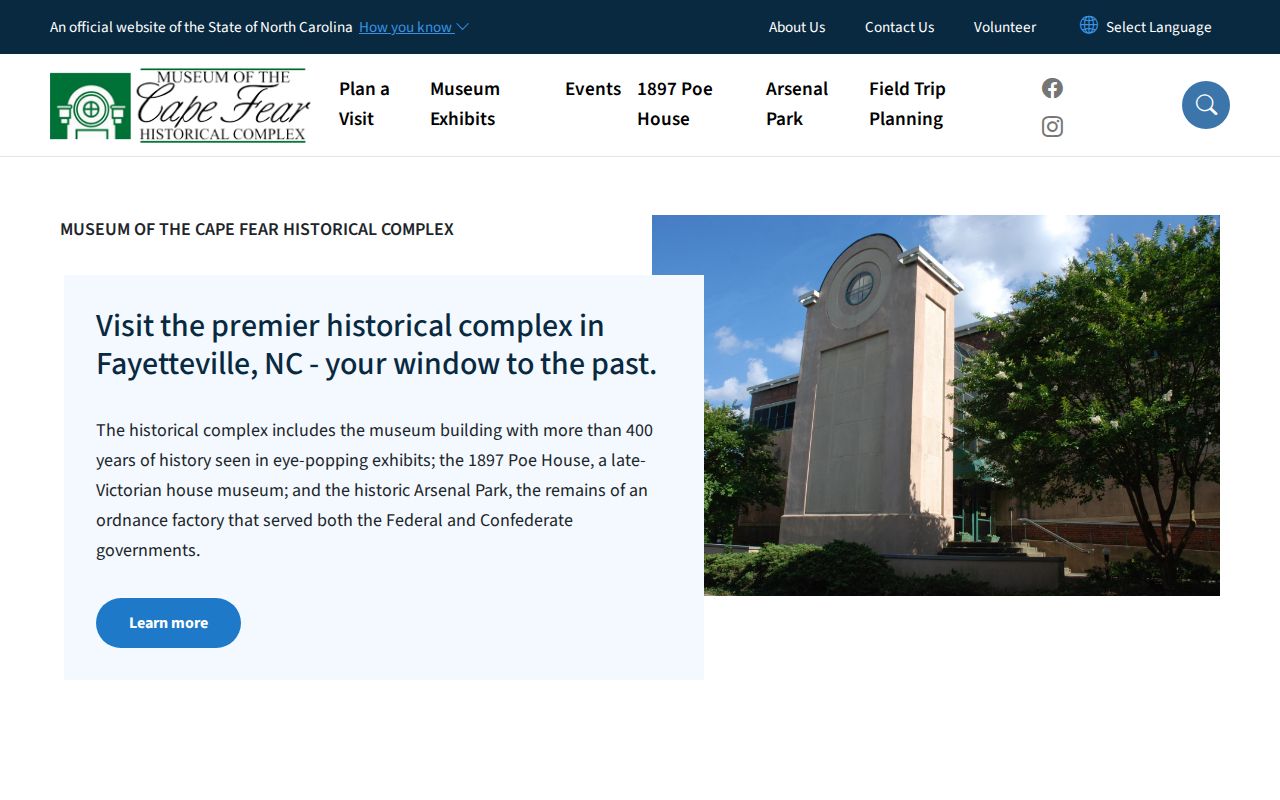
The museum preserves local history and material culture, but its official information does not provide a complete public name index for former occupants.
Fayetteville Headquarters Library’s Local & State History Room holds directories, maps, newspapers, census material, vital indexes, yearbooks, and photographs. Staff will try to answer a specific historical question and retrieve books or microfilm, but they do not perform broad Fayetteville family-history research. Note: physical shelf holdings and reverse-directory years should be confirmed with library staff before relying on a particular volume.
Fayetteville Census Pairing for Past Residents
A Fayetteville directory can suggest the people at an address in a particular publication year. The federal census adds household relationships, ages, birthplaces, and occupations for a Fayetteville census date, subject to the 72-year public-release rule. Match the street, house number where present, household members, and time period rather than assuming two records are identical. A directory may include adults, heads of household, businesses, or subscribers only.
Use this Fayetteville process: Fayetteville directory street and number → printed occupant and phone clue → nearest released census → household relationships and age pattern → Fayetteville deed or probate record for the same period. Record a move, widow notation, name variant, or missing year as a question to test with the next source. A person leaving a directory may have moved, died, been omitted, or fallen into a publication gap.
Fayetteville Resident Address Maps
Fayetteville Sanborn fire-insurance maps help test whether a building, street layout, or intersection persisted across a directory gap. The documented Fayetteville sequence includes 1885, 1891, 1896, 1908, 1914, 1923, 1930, and 1958. Compare the Fayetteville footprint, nearby intersections, street label, and building use with the directory and legal description. A map can support continuity, but it does not prove a current street number was used in every earlier year.
The Library of Congress January 1891 Fayetteville Sanborn item is a free starting point. Other listed years may require library or archive confirmation. The 1831 city fire and 1865 wartime destruction are further reasons to test building continuity with maps, deeds, plats, and newspapers rather than presume the modern structure stood on the earlier parcel.
Fayetteville Resident Address Changes
Address strings can change without moving the physical place. Cumberland’s 2008 addressing work scanned plans and built a web map for the 911 database, replacing 21 four-drawer file cabinets. County Addressing also handles address verification and corrections. These local records changes help explain why an old rural-route, duplicate street name, or printed community label may not match a current GIS result word for word.
I-295 work produced documented 2025 changes, including Century Circle to Midship Road and portions of Strickland Bridge Road, Barefoot Road, and Eunice Drive receiving new names. Use current GIS, a plat, nearby intersections, map layers, annexation material, and existing signs to bridge the change. Do not replace the historical spelling in the log. Note: a blank search after a road change calls for a crosswalk, not a conclusion that the older address was wrong.
Fayetteville Past Households and Obituaries
Probate can close a property trail by naming a decedent, administrator, heirs, property, and dates. Current estate files are handled through the Cumberland County Clerk, while historical estate and probate material may appear through the State Archives or FamilySearch collections. An obituary can add a death date, family connection, or community reference, but it is not a substitute for a recorded transfer.
For an obituary request, give the Cumberland Library Local & State History Room a specific question and the date of death. The newspaper holdings are not indexed by name alone, and staff need that date to begin. Out-of-county researchers may submit a question and can receive up to five copies without charge, with additional copies at the documented per-copy charge plus postage.
Lawful use. Fayetteville house-history research can support family history, estate questions, and personal curiosity. Never use a former address or record trail to track, threaten, harass, or harm a living person; North Carolina’s anti-stalking law can apply to repeated unwanted conduct.