
Fayetteville City Directory Collections
Fayetteville has a longer directory trail than a single online catalog suggests. Bernard’s Wilmington and Fayetteville Directory and Handbook reaches 1866–67. Confirmed digital and bibliography records then document Hill, Gardiner, and American Legion volumes across the twentieth century. Some are scans, while later runs are references in the NPS and North Carolina Historic Preservation Office bibliography. That difference matters: a bibliography proves a documented run, not that every book is presently on a local shelf. Call the library before a special trip for a particular year.
| Fayetteville collection | Documented years | Where held | Access route |
|---|---|---|---|
| Bernard’s Directory and Handbook | 1866–67 | NPS/HPO bibliography | Confirm physical holding |
| Hill, Gardiner, and Legion directories | 1909–10, 1915–16, 1924, 1928 | DigitalNC, UNC, Duke, and library collections | Several free scans |
| Hill’s Fayetteville runs | 1937, 1939, 1948–55 | Local or university holdings in the HPO bibliography | Confirm shelf or archive access |
| Postwar Fayetteville directories | 1951, 1953, 1954, 1956–69 references; 1968 record | DigitalNC and Cumberland Library contribution | Record page or staff help |
The sequence has gaps. A missing name can reflect adult-only coverage, a changed spelling, an unscanned book, a telephone omission, or a move. It does not establish that someone was absent from Fayetteville. The Downtown Fayetteville bibliography is a useful year checklist, while the volume itself supplies the evidence to cite.
Fayetteville History Room Desk
The Cumberland County Public Library’s Local & State History Room is the practical local directory desk. It is on the second floor of Headquarters Library, 300 Maiden Lane, Fayetteville, NC 28301-5000, at 910-483-7727 ext. 1365. Its North Carolina Reference and Genealogy Reference collections include directories, yearbooks, maps, pamphlets, newspapers, census records, vital-record indexes, and photographs. Staff will attempt a specific historical question and retrieve books or microfilm, but they do not undertake extensive open-ended family research.
For an out-of-county request, a focused question can be sent without a lookup charge and includes up to five free copies. Extra copies cost $0.15 each plus postage. Supply a person or address, a likely date, and the record type. For an obituary request, staff need a death date because the historical newspapers are not indexed by name alone. This is also the sensible fallback when a scan is unclear, a listed year is not online, or a householder section needs checking.
The library’s house-history research guide is a useful lead-in to its local-history assistance.
The guide reinforces the local workflow: start with a narrow question, then request the relevant directory, map, newspaper, or microfilm source rather than assuming a complete person-name index exists.
Fayetteville Digital Directory Scans
DigitalNC is the online starting point for several Fayetteville directory volumes. Its record pages preserve collection context even if a direct PDF path changes. The 1909–10 Hill volume is record 25065; the Gardiner 1915–16 volume is 25055; Hill’s 1924 is 25054; and the American Legion 1928 directory is 25070. A later Hill’s Fayetteville record for 1968 is 25063, credited to Cumberland County Public Library.
Open the record page before citing a page image. It identifies the item and holding context, whereas a saved scan can lose that information. Treat the printed listing as historical publication content, not current identity evidence. A street, community label, business address, or spouse notation becomes much stronger when another dated source supports it.
The DigitalNC 1909–1910 Fayetteville directory record shows the kind of digitized volume available from this collection.
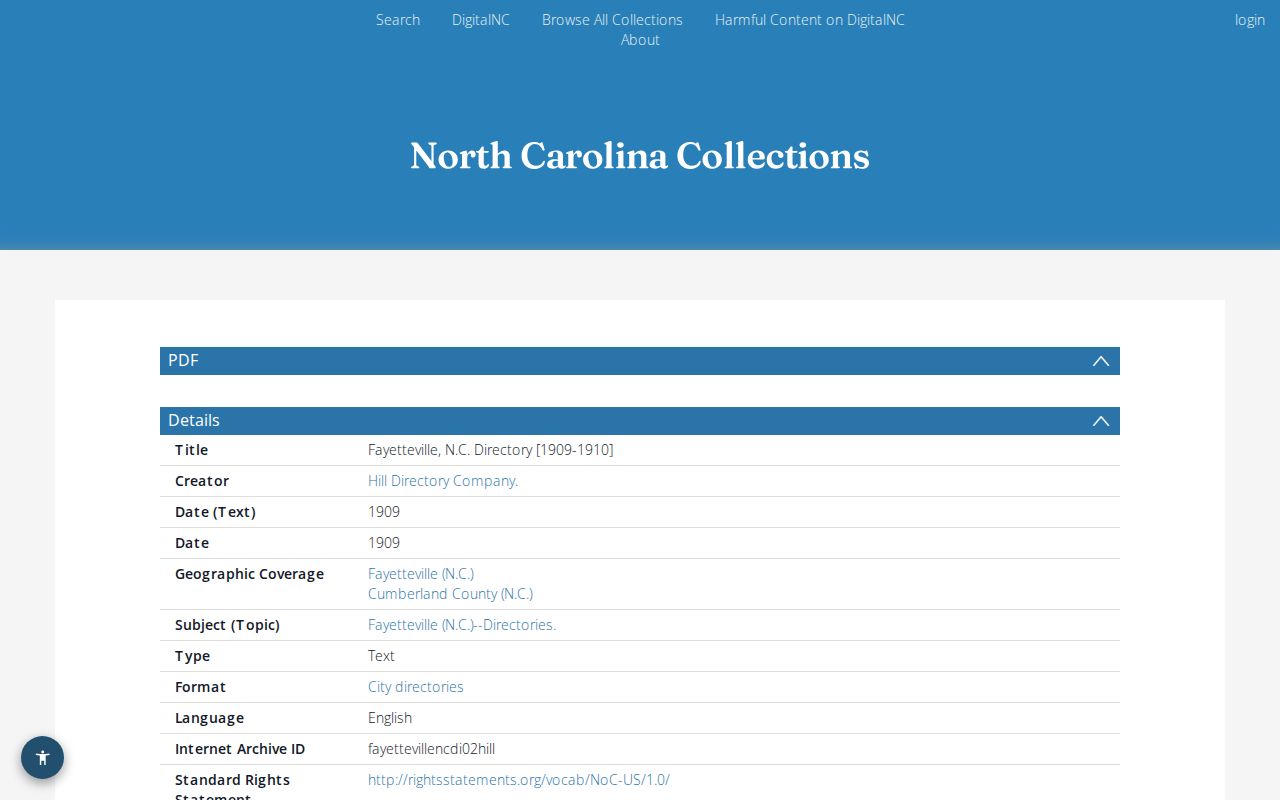
A scan can answer a name-to-address question quickly, while the Local & State History Room and university holdings remain the fallback for a year DigitalNC does not show.
Reading a Fayetteville City Directory Entry
Hill’s 1959 introduction provides a clear field key for a Fayetteville directory entry. The alphabetical section records adult residents by name, marital status, work, and address. Firm and corporation entries can name officials or personnel and give a business address. That business address should not be treated as a home address. Read the abbreviation key in the volume before transcribing a line, especially where a wife’s name or widow notation appears.
| Adult resident name | The alphabetical entry, including initials or name variants used by the publisher. |
|---|---|
| Marital or widow notation | A relationship clue, sometimes using a deceased husband’s initial. |
| Work and firm detail | An occupation or firm/personnel reference, which may lead to a separate business record. |
| Street address | The printed house number and street for that edition, not proof of a modern address. |
| Householder marks | Street-guide ownership or occupancy notation and telephone information where the volume uses it. |
- Criss-cross directory
- A reverse directory arranged by street and number so an address can lead to a listed householder or business.
- Householder index
- The street-guide portion that groups numbered locations under each street, with intersections and occupancy clues.
- Abbreviation key
- The volume’s own explanation of shortened words and symbols. Read it before drawing a family conclusion from a mark.
Copy the entry and the abbreviation key together. A single letter or mark can change whether a line is read as a residence, a business listing, or a widow reference.
The 1959 Fayetteville City Directory
The 1959 volume was four reference systems in one, a useful story of how Fayetteville residents were indexed before web search. It opened with Yellow Pages, followed by an alphabetical list, a Householders Directory with a street and avenue guide, and a numerical telephone directory. The householder section arranged numbered streets numerically and named streets alphabetically. Under a street, residence and business numbers appeared in numerical order, often with intersecting streets, householder or business, occupancy notation, and telephone number.
That architecture supports a three-way check. An alphabetical result supplies a printed address. The street guide tests who or what was listed at the number. A numerical phone listing can help when the name is hard to read or a variant spelling interrupts the search. The introduction also names Fayetteville, Bonnie Doone, Drake Park, East Fayetteville, Honeycutt, Lakedale, Lafayette Village, Massey Hill, and Myrtle Hill in its directory geography, so an older community label may be meaningful.
Fayetteville Directory Cross-Checks
Use a Fayetteville city directory in the direction the question requires. For an address-first search, find a named street alphabetically or a numbered street numerically, locate the building number, and read the entry opposite it. For a name-first search, start in the alphabetical list, then check the street section for nearby entries and telephone context. A phone-first search begins with the numerical section and must be confirmed in both other sections.
Old names and numbers need a geographic check. Search the old and new street spellings, nearby intersections, and local businesses. The modern parcel route is intentionally separate: when a current address question replaces a historic household question, use the Fayetteville street directory records chain rather than assuming a printed entry maps directly to a current parcel.
Note: A directory is an annual publication snapshot, so record the edition year and page before comparing a person, telephone number, or address to another source.
Fayetteville Directories and Census
Federal population census releases follow the 72-year rule. Pair a directory year with the nearest available census by comparing street, household members, ages, birthplace, and work. The sources have different dates and purposes. These volumes can fill years between censuses, but they may favor adults, heads of household, businesses, and telephone subscribers. A matching surname on the same street is not enough by itself.
- Locate the earliest known Fayetteville directory entry and capture its name, address, notation, and page.
- Build a year-by-year table of moves, spelling changes, spouse or widow notation, telephone number, and street-guide result.
- Match a nearby released census using the address plus household context, not only the printed surname.
- Use the street guide to identify adjacent listings, then test whether another source confirms a shared place and time.
- Close a break with an obituary, deed, probate file, or later directory, recording what each source actually proves.
Absence from a volume can signal a move or death, but it can also reflect a publication gap, a listing rule, or a new name. A court docket, recorded deed, or vital copy may be useful for a different question, but each has its own access limits.
Fayetteville Directory Clues Beyond Print
Newspapers, yearbooks, maps, and archives can test a directory clue. The State Archives newspaper guide lists Fayetteville Observer weekly runs for 1816–19, 1823–65, and 1883–1900, plus selected semiweekly and daily runs, the Fayetteville Index for 1909–17, the Eagle, and early Fayetteville Gazette issues. These are reel and catalog holdings, not a promise of complete online text. The library’s modern Observer archive reaches back to 1988.
The North Carolina State Archives newspaper guide identifies the historical newspaper route.

Use a date of death before asking library staff to look for an obituary. For address continuity, compare the directory to Sanborn map years documented for Fayetteville: 1885, 1891, 1896, 1908, 1914, 1923, 1930, and 1958. The free January 1891 Library of Congress map can help compare a footprint, street label, and nearby intersection when numbering has changed.
Trace Families Through Fayetteville Directories
Family history work is strongest when the Fayetteville city directory is one part of a dated chain. Keep the printed spelling, address, directory year, page, and the part of the book used. Pair the result with a census, obituary, probate file, map, or recorded instrument according to the question. The Local & State History Room, State Archives, and FamilySearch provide useful alternatives when a printed run stops. FamilySearch estate and probate collections can identify heirs, administrators, witnesses, residence clues, and dates, subject to collection access restrictions.
A directory entry confirms that the publisher printed a particular name and address relationship for that edition. It does not prove every resident of the property, an exact move date, or a current identity. That careful distinction makes the historical trail more reliable for relatives, classmates, community history, and estate research.
Limits of Fayetteville Directories
Printed directories have real biases. They may omit children, people without telephone service, unlisted residents, short-term occupants, and anyone the publisher did not include. Historic fires and wartime destruction in Fayetteville are also caution flags for building and address continuity, even though this research did not verify a precise record-loss list. Never fill a gap by guessing that a modern structure or street string existed in an earlier edition.
When an entry matters, retain the page image, check the volume’s abbreviations, and seek an independent record from its custodian. Do not use directory clues to pursue a protected address or to harass anyone. The useful result is a documented historical connection, not a complete roster of people who may have lived in Fayetteville.